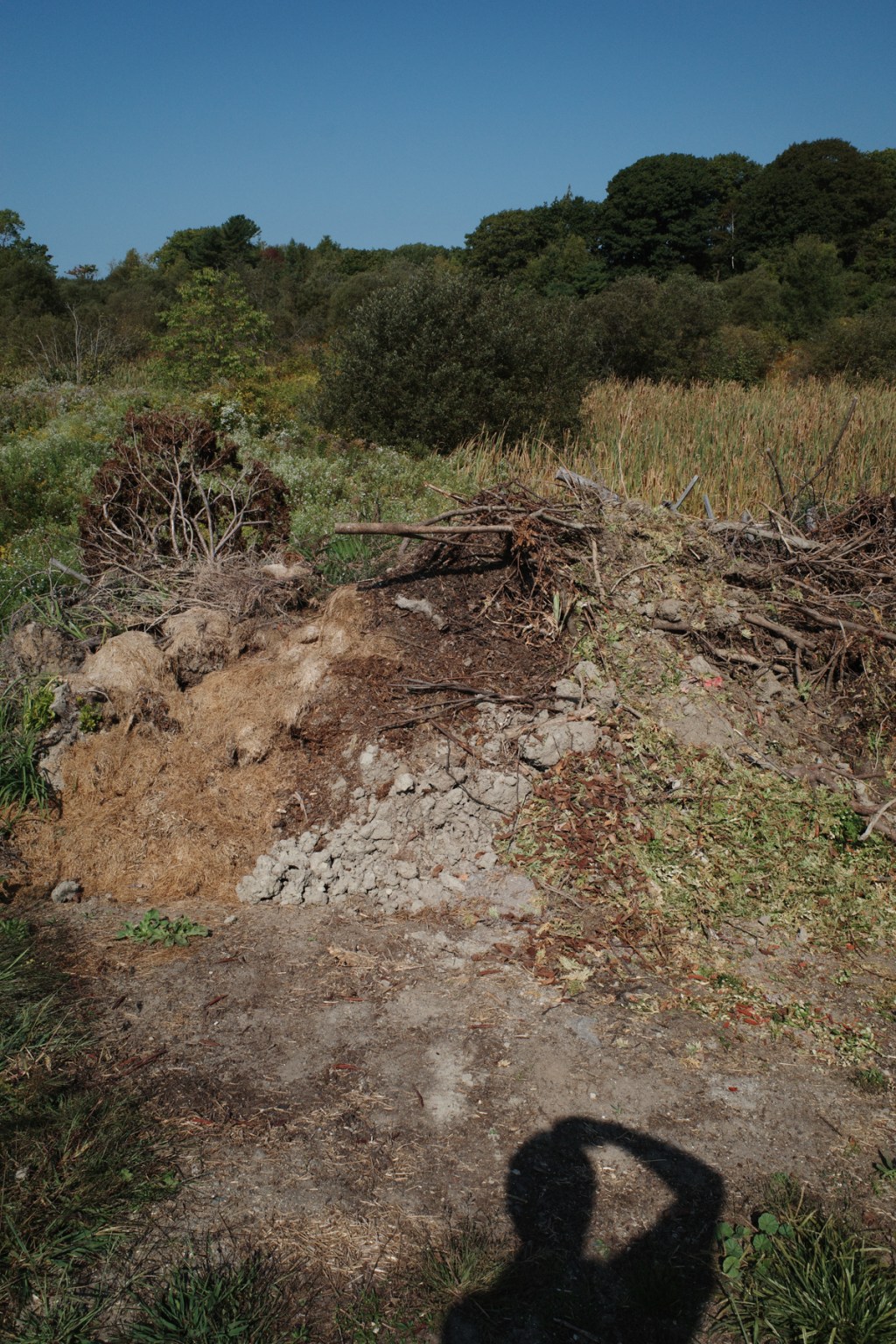
I could use these two photos to elaborate on the “Diary” and “Discard” pile. But I kept both of these in the diary. They lead one into another stage of choosing. These small decisions bear the weight of the arbitrary, because even if one “works” better than the other, there was no purpose in the first place. “The purposelessness of art” is oft-discussed, frequently forgotten. It’s also never true; everything can serve a purpose, or be viewed that way with effort. But the basic sentiment—that art need not explain itself in subsistence terms—is not easy to accept.
Some people reject it outright, and they are not only “insurance salesman.” I remember Ken Mikolowski at the University of Michigan patiently probing a student who voiced her frustration at not seeing the meaning of a poem. Over time, my sympathy with that classmate grows; passive acceptance of the irrational seems lazy to me.
Side by side, I think the left photo is more balanced. It’s sort of divided into thirds. The bare patch of dirt, the three compartments of brushpile matter, the three greens of the reeds, shrub, and trees.
But the left photo involves this decision: to show a photographer taking a picture of a free-standing pile of dirt. The right photo involves another: showing a photographer immersed in seeing the marsh. What’s the purpose? I was just walking around. Do I have a philosophy that pre-screens these things for me? Which one?