• Melody turns us from the environment: thoughts on texture

    Medium-distance outdoor shot of logs, ferns, and moss in Scarborough, ME forest by Maine musician Alex Silver, summer 2024. Emphasis on texture and structure.

    Dry grass. I told my housemate in Orléans, France that I liked fibrous foods, that I almost long to chew on a thick piece of rope. She told me I may have something from childhood.

    Playing guitar tonight, I was thinking about texture. After twenty minutes of exploring, listening, and responding to the strings, I looked up. The couch was vivid, green, and almost resonating with a visual timbre. The yellow light from the lamp bounced around dully.

    In music—or stories—melodies themselves can have texture, but more often they are surrounded by it. Precise colors and weights move on the surface of melodies and the notes are the music’s interior, like thoughts or spirit. But looking up at the couch tonight, my sensitivity to texture is high and I question melodies.

    Melodies, or concepts like “couch,” can intertwine with textures, but more often they distract from them. Melodies distract from the environment with airs of ready meaning. Like looking into the woods and suddenly noticing a moving animal crossing a scene, our minds follow stories, motion, and any other sign of significance. I’m interested in heightening more of the environment, so that textures are as important as notes, or words, or s-o-n-g. As foregrounded as any spirit that dwells inside. Surfaces should be as ready as ideas.

    I’ve looked at the woods many times, raised a camera, and hoped to catch the depth of the melody. It’s unlikely to happen, usually, because the woods is so noisy. The melody, poem, song—whatever I thought I saw is obscured. This photo from the summer, nearby, catches depth. Whether it captures melody or not, you determine. But I think it catches surfaces.

  • Deciding on “essais.” Maturing with feelings of the arbitrary.

    I could use these two photos to elaborate on the “Diary” and “Discard” pile. But I kept both of these in the diary. They lead one into another stage of choosing. These small decisions bear the weight of the arbitrary, because even if one “works” better than the other, there was no purpose in the first place. “The purposelessness of art” is oft-discussed, frequently forgotten. It’s also never true; everything can serve a purpose, or be viewed that way with effort. But the basic sentiment—that art need not explain itself in subsistence terms—is not easy to accept.

    Some people reject it outright, and they are not only “insurance salesman.” I remember Ken Mikolowski at the University of Michigan patiently probing a student who voiced her frustration at not seeing the meaning of a poem. Over time, my sympathy with that classmate grows; passive acceptance of the irrational seems lazy to me.

    Side by side, I think the left photo is more balanced. It’s sort of divided into thirds. The bare patch of dirt, the three compartments of brushpile matter, the three greens of the reeds, shrub, and trees.

    But the left photo involves this decision: to show a photographer taking a picture of a free-standing pile of dirt. The right photo involves another: showing a photographer immersed in seeing the marsh. What’s the purpose? I was just walking around. Do I have a philosophy that pre-screens these things for me? Which one?

  • ‘The Grey Wall’ text from L’amour – La Mort publication

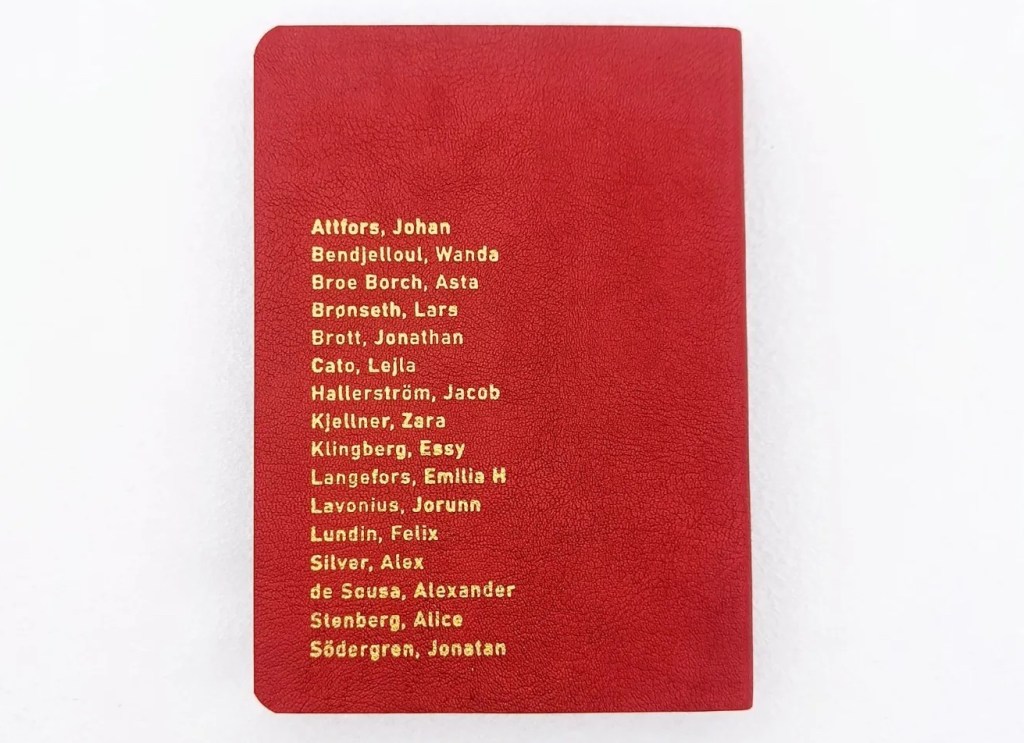
    Back cover of L'amour - La mort No. 13 Travelers from Stockholm, Sweden. List of contributors, including the musician Alex Silver.

    Grace à vous, Jacob Hallerström, a second piece of my writing was published in Stockholm’s L’amour – La Mort literary magazine this year. I visited Jacob in Sweden in 2021, where his friendly community of musicians and Europeans welcomed me surprisingly warmly. I felt like Ginsberg crowned The King of May! I even spent some extra time ambling for falafel with the magazine’s other main editor, the wild poet Jonathan Brott. “Good people,” as our trumpet player Robert Ketcham used to say of one person.

    Since the text of this issue, Resenärer (Travelers), is mostly in Swedish and my fellow anglophones/Americans are unlikely to find it, I’m digitizing it here. In fact, I wrote it for a writing prompt in a Teaching Writing class for my K-8 teaching certificate, procrastinating as usual but getting friendly remarks from my classmate:

    The Grey Wall from L’amour – La Mort, Nr.13 – Resenärer

    The grey wall became part of a song, it became a reference and a symbol for a certain state of mind but before that it was an actual event and an awful and beautiful image that appeared in my own life on a specific day in my early twenties when we were traveling across the country to move to Washington. Away from Ann Arbor and Michigan altogether and to start a new phase of life unmoored, without the ballast of old days and friends and family or places. Maybe that’s why the grey wall was so scary and awesome in the moonlight.

    It might’ve been in Utah or Montana or Wyoming — it was somewhere out West and now it’s so tied up and enduring as an idea that even though we never went to Utah that year, it seems it could just as well be a grey wall in Utah that was so awful and beautiful in the moonlight that night. We were descending for what seemed like a very long time, on some long incline that didn’t really matter in terms of length because we were driving ten hours a day no matter what and time wasn’t really the same sort of container it usually is. We just traveled through time like the wide space of the plains that got covered in trillions of pointillated blades of sharp or soft grass and dry mud; we travelled through time like it was a big bathtub filled with empty air. So it may have been an hour we descended and the incline was eerie like we were headed down to Hell, by a sort of optical trick; we were sinking into the earth like we’d fallen for some scheme out of a tourist trap billboard.

    We were listening to For Emma, Forever Ago, specifically as a comfort and it was as good as any time I’ve heard it, and just as always in powerful moments I redefined my memory of it; that valley became the new spot in the cache. I got out of the car when we stopped at the bottom and the grey wall was just there in Montana or Wyoming where the light was so bright and pale that the grey wall jumped out at me and Sarah was still in the car and even though I was scared, I was in awe and it quickly became a symbol and a representation of a feeling that was only just starting then but was clear to be a harbinger and an entryway into another era and another thick block of identity isolated in life and untouchable post-fact. I can’t touch it now but I can stand easily at the grey wall in my mind as if it were there — though one feature of it, of being there, is it doesn’t feel like being here, on earth, in this way, in this self, in this time, in this culture, this milieu, this friends-group, this family, this space — it feels like another space, like it’s orbiting what is my life now. And that’s ok — the grey wall is now a dream and I’m grateful to have stood so close.

    December 2022
    Portland, Maine

  • Photographs as diary and seeing recent moments as “past”

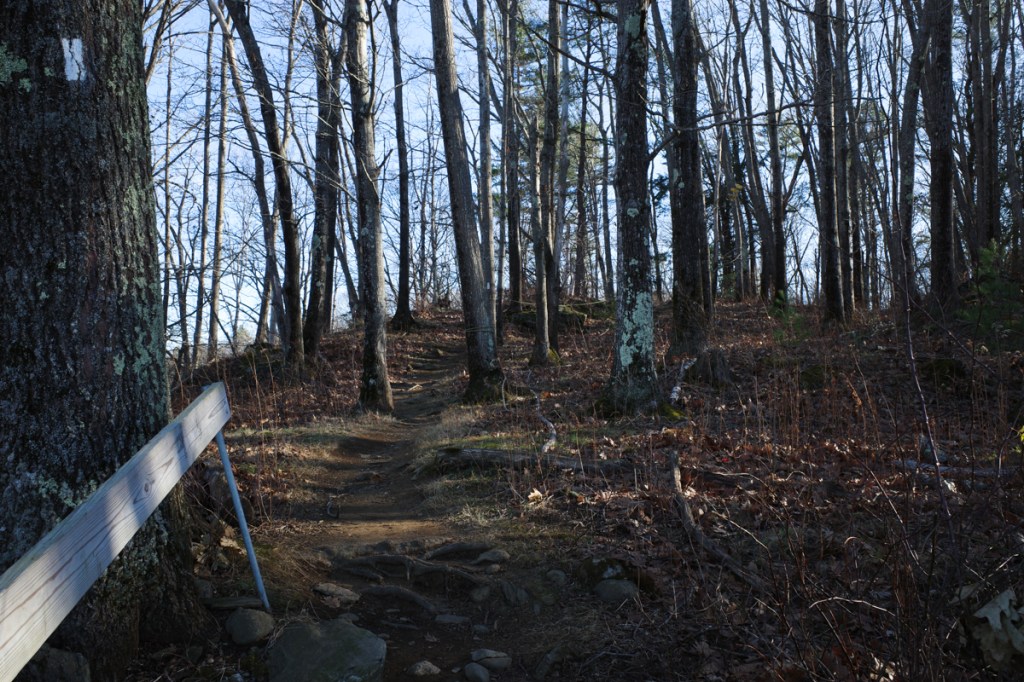
    Medium-distance shot of hiking path and stone steps in Scarborough, Maine taken by the musician Alex Silver.

    I thought I’d start with a photograph. Though I’ve thought of my photographing this way for a while, I recently titled my folders “Diary” and “Discard.” I’m planning to keep both current, and I’ll review the pictures in each regularly. This is the same way I’m keeping music, especially the harder, more ephemeral stuff. If I keep some attempts organized in this way (Merleau-Ponty said every Cézanne work was an “essai”; Cara called my clatter in the other room a “stance,” warming my heart), I can look at mistakes and successes with a new mind at a later time, having abandoned the one that made the decisions. I can decide how I feel about the mind I had.

    This photo of stone steps, a railing, and an ascending trail is from last weekend walking near home in Scarborough, Maine. It did make into the “Diary” folder then. I don’t know if it’ll make into any other category, but it did surprise me when I looked at it. What surprised me especially was that it was one week old. It seemed like a memento from another, perhaps special time. Like if I walked over there today, I would find it changed. It happily reminds me that I am seeing things now as commonplace-if-notable, but—like when I turned the bend at Triglav National Park this hill me reminds me of—I may indeed be living in a special time.