Tag: phenomenology

  • Visiting a House: Philosophical Fiction (Excerpt 11)

    Scarborough, Maine, April 2024.

    I taught English in France in 2019, and over the holiday break I decided to commit time to writing fiction in the public library in Orléans. Besides a memorable duck dinner with a roommate’s family on Christmas Day, I didn’t have any obligations. I went every day for about about two weeks, buying cheap espressos at the stand by the tram hub, often on both ends of the sessions writing. It was peaceful, though I was never alone at the huge tables in the library’s vaulted reading room. I’d write by hand, then take the tram home and type out the text on my laptop—eventually it came to some 80 pages of penciled writing.

    When I got back, I edited some of it down and created a Tumblr for “serialized fiction.” Actually, the practice was to edit something down and publish it as an excerpt, one section at a time. I called it Dog Mountain Journals. For now, I’m calling it Visiting a House to reflect the dry simplicity and opaqueness of the character, who is un-named and un-gendered, and the single-mindedness of the prose’s task: to describe perception of a house from many angles. Sometimes I can barely read this, sometimes I’m hungry for its precision. Certainly it’s not entertainment! I haven’t let it go, and I’m going to edit down some of it—again a piece at a time—and publish it at visitingahouse.tumblr.com.

    My friend Jacob Hallerström in Sweden read my first excerpts as they came out, and he offered to publish one in L’amour – La Mort, a literary magazine from Sweden he co-edits.

    Excerpt from Visiting a House: Philosophical Fiction

    11.

    The next day I walked outside before drinking any coffee, which is very rare. I think this is a good sign.

    Read more . . .
  • Essai: “Like fresh water at the zoo”

    Recently I’ve spent a lot of time figuring out my internet flow. Considering the evolution and present dominance of streaming, I think the internet ought to be the best place to interact with my music. If streaming is the routine (it’s mine too, mostly—Qobuz and my little internet radio), then things like records and printed materials should be secondary, even if they’re perceptually ideal.

    I think I have a schematic that works now: polished releases on major streaming plaforms and Bandcamp, drafts/iterations on SoundCloud, full-length visual stuff on YouTube. The hard part is not spending too much time trying to master social media. The plan there is to post snippets that might lead people out to SoundCloud to follow my process.

    I’ve always been one to seek and enjoy a good “setup,” and this flow matters to me because now I can think less about where to put things, or why—and I can focus more on deeper, more sensual aspects of attempting artistry.

    This one is the twin of the previous Essai: “I gripped it under my sweat” recording. I made both on the same day and had put this one in the “Keep” folder. It’s weird how one day a recording fulfills something and another day it seems strange. Now this one suits me, and I like this line in the present political moment:

    Breaking through
    old news
    is like fresh water
    at the zoo.

  • Photo diary: Cézanne and tracing appearances as they emerge

    Scarborough, Maine, August 16, 2024

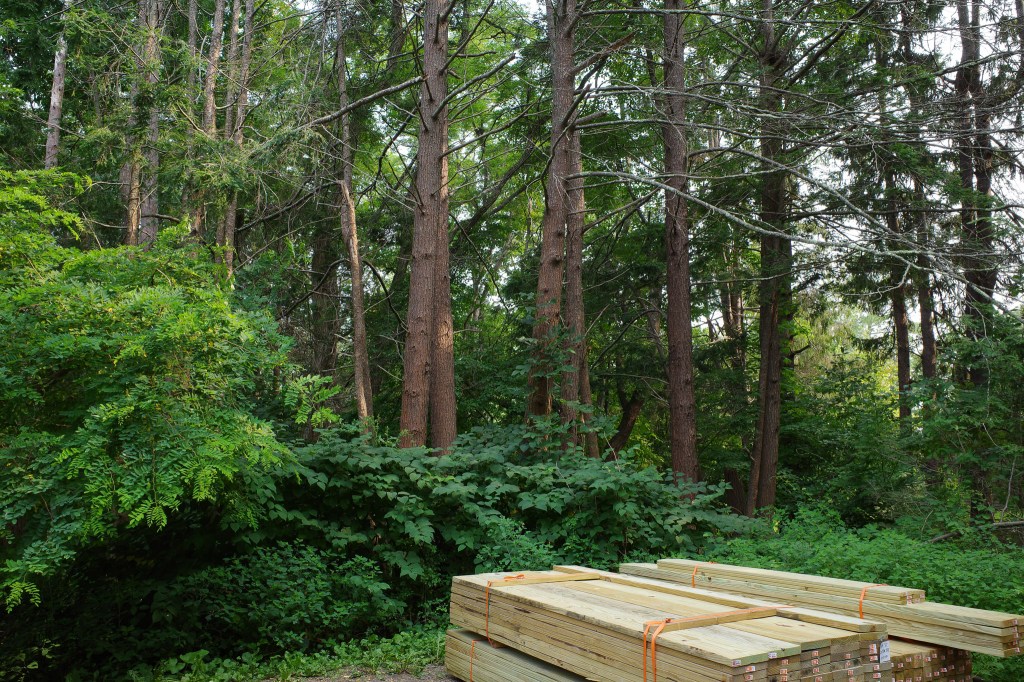
    Where in the past I may have erased construction sites—orange cones, yellow bulldozers, exposed concrete—from my vision, for the last few years I’m usually drawn to these happenings, even find them beautiful. The reality is that this is how everything (modern) we know is constructed, and there is a freshness to feeling that reality, even if there is also a sense of loss.

    In sound, or in photos, tracing or creating the world as it emerges is a preoccupation I have. I’m deeply reverent about Merleau-Ponty’s essay on Cézanne, called “Cézanne’s Doubt.” He discusses this sensation of seeing appearances as they are at the beginning of the world—which for Merleau-Ponty’s phenomenology is a perceptual world, I suppose. But he also alludes to an actual, chronological beginning of the animal world. Cézanne’s work apparently shows this, and this is partially why there is such eerie “non-humanity” to his paintings. I relate to this non-humanity, and I feel anger about humans’ habit (a natural behavior) of focusing on each other. It’s a matter of seeing more broadly, including humans in the landscape rather than making them ideal protagonists.