I visited my good friend, the journalist and musician Jacob Hallerström, in the middle of August. He and his partner taught me so much about the history of Sweden, especially how its culture conceives of itself through art and architecture. We visited the National Museum, Carl Eldh’s studio, August Strindberg’s apartment, and the world-historical collage that is City Hall, with its grandiose attempt at National Romanticism.
We also went swimming in the archipelago at what my friends dubbed its “capital,” the small town of Vaxholm. This is the last picture I took on the trip. I’d gone on and on about the “pelargos” in the windows with such clear light. Anaïs suggested I take a photo when I admired this one.
Dry grass. I told my housemate in Orléans, France that I liked fibrous foods, that I almost long to chew on a thick piece of rope. She told me I may have something from childhood.
Playing guitar tonight, I was thinking about texture. After twenty minutes of exploring, listening, and responding to the strings, I looked up. The couch was vivid, green, and almost resonating with a visual timbre. The yellow light from the lamp bounced around dully.
In music—or stories—melodies themselves can have texture, but more often they are surrounded by it. Precise colors and weights move on the surface of melodies and the notes are the music’s interior, like thoughts or spirit. But looking up at the couch tonight, my sensitivity to texture is high and I question melodies.
Melodies, or concepts like “couch,” can intertwine with textures, but more often they distract from them. Melodies distract from the environment with airs of ready meaning. Like looking into the woods and suddenly noticing a moving animal crossing a scene, our minds follow stories, motion, and any other sign of significance. I’m interested in heightening more of the environment, so that textures are as important as notes, or words, or s-o-n-g. As foregrounded as any spirit that dwells inside. Surfaces should be as ready as ideas.
I’ve looked at the woods many times, raised a camera, and hoped to catch the depth of the melody. It’s unlikely to happen, usually, because the woods is so noisy. The melody, poem, song—whatever I thought I saw is obscured. This photo from the summer, nearby, catches depth. Whether it captures melody or not, you determine. But I think it catches surfaces.
I could use these two photos to elaborate on the “Diary” and “Discard” pile. But I kept both of these in the diary. They lead one into another stage of choosing. These small decisions bear the weight of the arbitrary, because even if one “works” better than the other, there was no purpose in the first place. “The purposelessness of art” is oft-discussed, frequently forgotten. It’s also never true; everything can serve a purpose, or be viewed that way with effort. But the basic sentiment—that art need not explain itself in subsistence terms—is not easy to accept.
Some people reject it outright, and they are not only “insurance salesman.” I remember Ken Mikolowski at the University of Michigan patiently probing a student who voiced her frustration at not seeing the meaning of a poem. Over time, my sympathy with that classmate grows; passive acceptance of the irrational seems lazy to me.
Side by side, I think the left photo is more balanced. It’s sort of divided into thirds. The bare patch of dirt, the three compartments of brushpile matter, the three greens of the reeds, shrub, and trees.
But the left photo involves this decision: to show a photographer taking a picture of a free-standing pile of dirt. The right photo involves another: showing a photographer immersed in seeing the marsh. What’s the purpose? I was just walking around. Do I have a philosophy that pre-screens these things for me? Which one?
I thought I’d start with a photograph. Though I’ve thought of my photographing this way for a while, I recently titled my folders “Diary” and “Discard.” I’m planning to keep both current, and I’ll review the pictures in each regularly. This is the same way I’m keeping music, especially the harder, more ephemeral stuff. If I keep some attempts organized in this way (Merleau-Ponty said every Cézanne work was an “essai”; Cara called my clatter in the other room a “stance,” warming my heart), I can look at mistakes and successes with a new mind at a later time, having abandoned the one that made the decisions. I can decide how I feel about the mind I had.
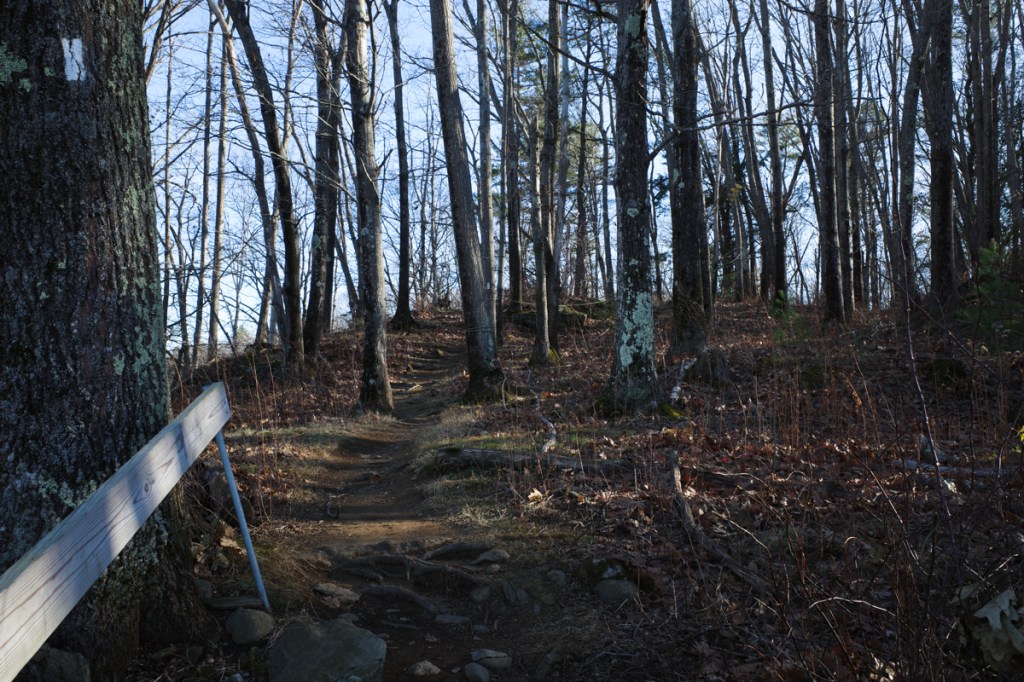
This photo of stone steps, a railing, and an ascending trail is from last weekend walking near home in Scarborough, Maine. It did make into the “Diary” folder then. I don’t know if it’ll make into any other category, but it did surprise me when I looked at it. What surprised me especially was that it was one week old. It seemed like a memento from another, perhaps special time. Like if I walked over there today, I would find it changed. It happily reminds me that I am seeing things now as commonplace-if-notable, but—like when I turned the bend at Triglav National Park this hill me reminds me of—I may indeed be living in a special time.