Tag: Writing

  • Statement on Current Intentions

    Think of this short statement on art like Robert Irwin’s Notes toward a Conditional Art. That writing’s purpose was not presentational or communicative, but rather done as a way to organize his work. Only later were those writings presented as a collection, paired with some essays he’d made to be published. It’s a fantastic book! He’s very good at looking at art historically in terms of its developments in representation and abstraction.

    In my case, the purpose is slightly more practical. I also wrote to organize myself—but would like anyone out there encountering my songs to have this writing available to them.

    Statement on Current Intentions

    When I was first starting out, I was especially interested in freak folk and making things that lyrically pushed a kind of Beat expansion-of-consciousness (a paradigmatic example of this sort of music would be Devendra Banhart’s Rejoicing in the Hands and Niño Rojo). I reeled back from that kind of free expression after a while and created more classically poetic songwriter works, songs that nonetheless dealt with consciousness and wrestled with feelings of detachment.

    But for the last ten years or so, I’ve gone back and forth between writing more traditionally-structured songs and focusing on music philosophically. Generally, I’ve put much more energy into the philosophical aspect of writing than anything else, and I even went deeply into philosophy study itself—to the point of taking courses and applying to graduate programs. That was mostly around the philosophy of perception.

    I should add that under the label of philosophical work I include the concrete practice of playing and writing. Just as philosophy grapples with questions that cannot yet be empirically or logically answered, I think I have been creating things and reflecting with little assurance of conclusions, i.e. finished work.

    All the while, I’ve tried to put things out into the world in forms to which I could commit. Sometimes I’ve given up—let’s say, for the “time being”—on finding evidence of my inquiry that was worth displaying as art. At other times I’ve been comfortable. Now, as I reach a point where I can envision creating “works” from all this experimentation, I think it would be rewarding to lay out a few principles, or intentions:

    —I want the song to be non-abstract
    —Stories and repetition involve or invite abstraction more certainly than improvisation
    —In these songs, there is no particular that is necessary, nor is there anything intended to be generalizable as “song” or essence
    —The constituent parts are honed and practiced and a valuable instance of the singer/player’s spirit
    —I want the songs to feel purposeful and explore existential meaning, not demonstrate meaningless-ness
    —A good analogy to these songs is an athletic* event: there are conditions, practiced behaviors, and the potential for valued instances, particular and whole

    *I haven’t read it, but Alva Noë’s book Infinite Baseball makes a similar analogy about art, I believe. I have read multiple of his other books, including Strange Tools, which I recommend passionately. I love his way of talking about figuring art out (understanding) and even explaining our early feeling of boredom in encountering a work for the first time.
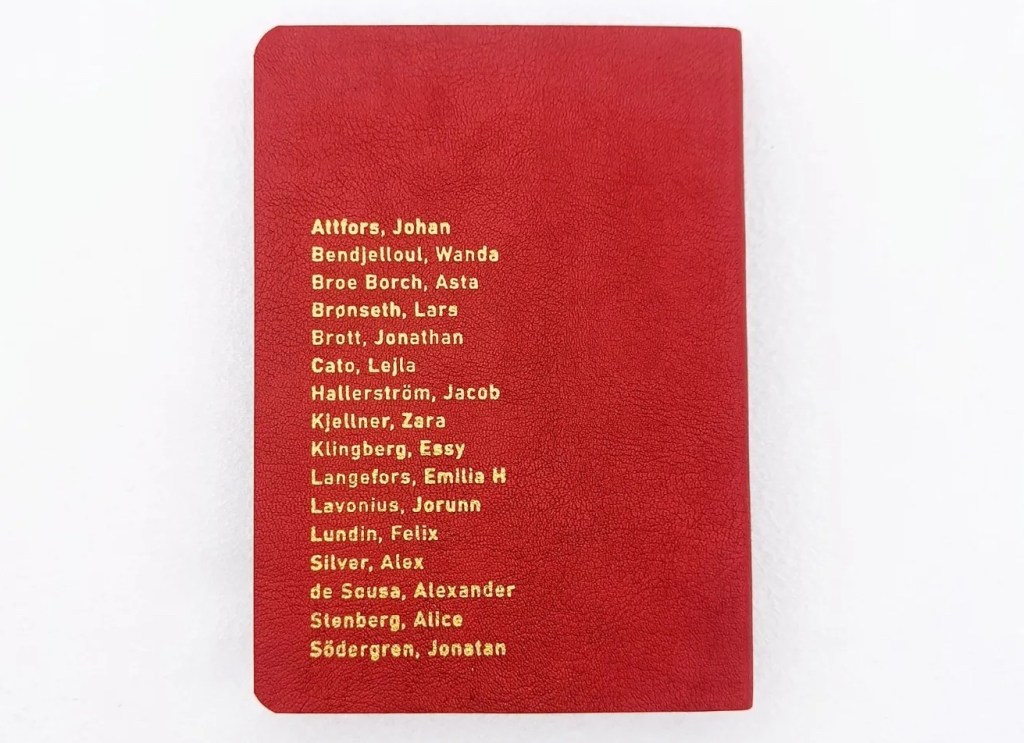
  • ‘The Grey Wall’ text from L’amour – La Mort publication

    Back cover of L'amour - La mort No. 13 Travelers from Stockholm, Sweden. List of contributors, including the musician Alex Silver.

    Grace à vous, Jacob Hallerström, a second piece of my writing was published in Stockholm’s L’amour – La Mort literary magazine this year. I visited Jacob in Sweden in 2021, where his friendly community of musicians and Europeans welcomed me surprisingly warmly. I felt like Ginsberg crowned The King of May! I even spent some extra time ambling for falafel with the magazine’s other main editor, the wild poet Jonathan Brott. “Good people,” as our trumpet player Robert Ketcham used to say of one person.

    Since the text of this issue, Resenärer (Travelers), is mostly in Swedish and my fellow anglophones/Americans are unlikely to find it, I’m digitizing it here. In fact, I wrote it for a writing prompt in a Teaching Writing class for my K-8 teaching certificate, procrastinating as usual but getting friendly remarks from my classmate:

    The Grey Wall from L’amour – La Mort, Nr.13 – Resenärer

    The grey wall became part of a song, it became a reference and a symbol for a certain state of mind but before that it was an actual event and an awful and beautiful image that appeared in my own life on a specific day in my early twenties when we were traveling across the country to move to Washington. Away from Ann Arbor and Michigan altogether and to start a new phase of life unmoored, without the ballast of old days and friends and family or places. Maybe that’s why the grey wall was so scary and awesome in the moonlight.

    It might’ve been in Utah or Montana or Wyoming — it was somewhere out West and now it’s so tied up and enduring as an idea that even though we never went to Utah that year, it seems it could just as well be a grey wall in Utah that was so awful and beautiful in the moonlight that night. We were descending for what seemed like a very long time, on some long incline that didn’t really matter in terms of length because we were driving ten hours a day no matter what and time wasn’t really the same sort of container it usually is. We just traveled through time like the wide space of the plains that got covered in trillions of pointillated blades of sharp or soft grass and dry mud; we travelled through time like it was a big bathtub filled with empty air. So it may have been an hour we descended and the incline was eerie like we were headed down to Hell, by a sort of optical trick; we were sinking into the earth like we’d fallen for some scheme out of a tourist trap billboard.

    We were listening to For Emma, Forever Ago, specifically as a comfort and it was as good as any time I’ve heard it, and just as always in powerful moments I redefined my memory of it; that valley became the new spot in the cache. I got out of the car when we stopped at the bottom and the grey wall was just there in Montana or Wyoming where the light was so bright and pale that the grey wall jumped out at me and Sarah was still in the car and even though I was scared, I was in awe and it quickly became a symbol and a representation of a feeling that was only just starting then but was clear to be a harbinger and an entryway into another era and another thick block of identity isolated in life and untouchable post-fact. I can’t touch it now but I can stand easily at the grey wall in my mind as if it were there — though one feature of it, of being there, is it doesn’t feel like being here, on earth, in this way, in this self, in this time, in this culture, this milieu, this friends-group, this family, this space — it feels like another space, like it’s orbiting what is my life now. And that’s ok — the grey wall is now a dream and I’m grateful to have stood so close.

    December 2022
    Portland, Maine